

At-Home Test Kits vs. a Venous Blood Draw: How Accurate Is No-Needle Testing?
"How accurate are the blood tests? I've heard mixed opinions on that style over an actual blood draw."
A patient asked us exactly that recently, and the question deserves a real answer, not reassurance. If you're going to make treatment decisions from a sample you collected at your kitchen table, you should know how it compares to the one a phlebotomist would have taken from your arm.
What the kit actually is
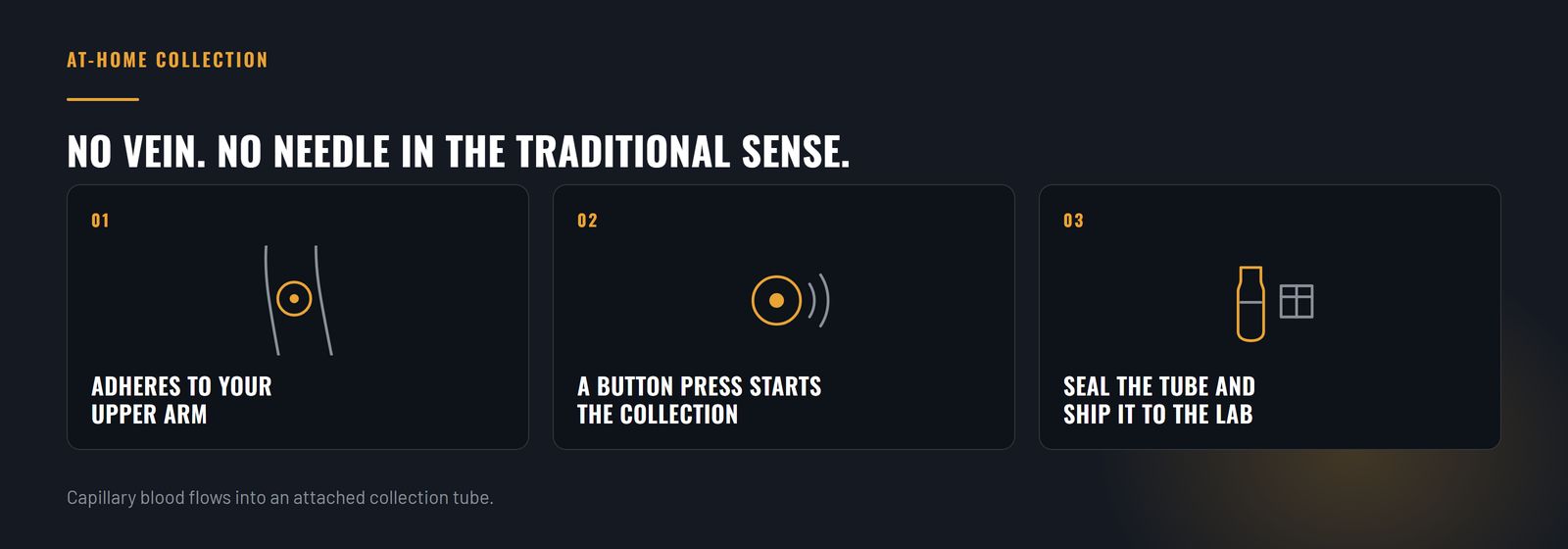
Using the kit is simple: the device sticks to your upper arm, you press a button to start the collection, and capillary blood flows into an attached collection tube. No vein, no needle in the traditional sense, no one hovering over your arm. You seal the tube and ship it to the lab.
The lab work doesn't change. Your sample goes to a laboratory and runs on laboratory equipment either way. What changes is where the blood comes from: capillary blood collected from the skin of your arm, instead of venous blood drawn from a vein.
How "accuracy" gets measured
When researchers validate a collection method, they don't ask people how they feel about it. They collect paired samples, from the same person at the same time, one from the device and one from a standard venous draw, and run both through the lab.
Then they plot the results. If you've seen the chart we sometimes share, a scatter of dots hugging a dark line, that's what it shows: each dot is a device result, and the line is what the venous draw measured. The closer the dots sit to the line, the closer the two methods agree.
What the published research shows
Researchers have studied blood microsampling, the category these devices belong to, side by side with conventional draws across many devices and many types of tests. A 2025 review in Analytical Science Advances gathered the head-to-head comparisons published over the previous four years, and the studies it collected showed strong agreement. In one validation of an at-home serum collection device, 97% of paired samples agreed with the venous result within ±20%, with a rank correlation above 0.9. Another at-home device showed a correlation of R² = 0.988 against liquid blood in its studied test. Other microsampling devices in the review showed similar patterns on their studied tests: correlations in the 0.9s, with results tracking the venous benchmark closely.
The same research carries two caveats worth knowing:
- Researchers measure agreement test by test. Validation for one panel doesn't automatically cover every test a lab can run, which is why the labs processing these samples validate the specific tests they report.
- Microsampling is the newer method, and the field says so. The same review calls for more large-scale validation studies, which is normal for any method earning its way into routine use.
Why this works well for hormone care
Hormone treatment isn't a one-time measurement. It's a baseline, then follow-ups, then adjustments: the same markers measured again and again over months.
That has two implications. First, ongoing care depends most on consistency of method: your provider tracks your results against your own earlier results, collected the same way each time. Second, every result lands in front of a provider who knows your history. A number that looks out of line with your picture gets questioned and retested, not blindly treated. That holds in any good practice, whatever the collection method.
When a traditional draw still makes sense
This might not be your answer, and we'd rather tell you so. Some tests and some situations still call for a venous draw. If you prefer a traditional lab draw, and some patients do, that option stays open. And if you've had recent bloodwork done elsewhere, bring it; if it's recent and complete enough, we'll use it so you don't pay twice.
We offer the at-home kit because, for the panels used in routine hormone care, the published comparisons support it, and because in a state the size of Montana, the drive to a draw station is the main reason men put testing off for another year. A test that happens beats a slightly different test that doesn't.
Getting started
If you've been putting off finding out where your levels are, the first step costs nothing.
This article is general information, not medical advice. Lab testing and treatment decisions are made with a licensed provider based on your individual evaluation. Source: Thaitumu M, et al., "Connecting the Dots: Bridging Microsamples and Conventional Blood Matrices in Metabolic Biomarker Analysis," Analytical Science Advances, 2025.